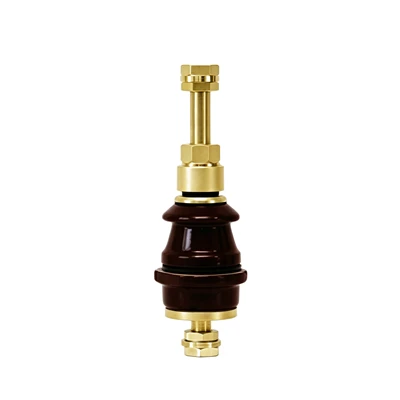
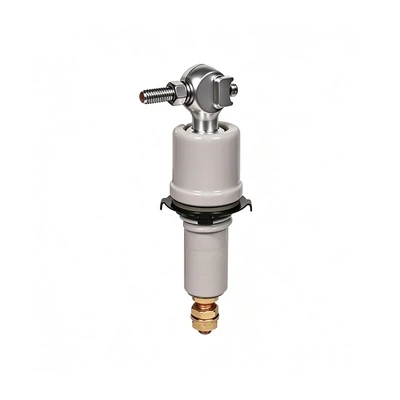
The working principle of transformer bushings is based on capacitive voltage division and a multi-layer insulation structure. Its core is the uniform distribution of the electric field within the internal capacitor core, preventing partial discharge and insulation breakdown, thus safely leading the high and low voltage leads from the transformer to the outside of the tank. It not only carries current, continuously passing load current during operation, but also must withstand instantaneous high current and high temperature under extreme conditions such as short circuits.
Detailed Explanation of Working Principle
Capacitive Voltage Division Mechanism
Capacitive bushings (commonly used in 66kV and above high-voltage systems) have multiple layers of metal foil (aluminum foil) and insulating paper alternately wound to form a "capacitor core," constituting a series of series-connected capacitor shields. This structure utilizes the principle of capacitive voltage division to make the voltage distribution along the length of the bushing more uniform, avoiding insulation failure caused by electric field concentration.
Synergistic Effect of Main Insulation and External Insulation
Main Insulation: A cylindrical structure composed of oil-impregnated cable paper and capacitor shields, providing primary electrical isolation.
External Insulation: Typically made of porcelain or composite materials, it withstands creepage distance requirements under external environmental conditions (such as rain, snow, and dirt) to ensure insulation strength to ground.
Sealing and Thermal Stability Design
The bushing is a fully sealed structure filled with insulating oil. An oil conservator adjusts for volume expansion caused by temperature changes, and an oil gauge monitors the oil level. The structure is spring-loaded to compensate for deformation caused by thermal expansion and contraction, ensuring long-term sealing performance.
Equalization and Grounding Protection
An equalization ball is located at the tail end to improve the electric field distribution and reduce the insulation distance between the tail end and the grounding component. The small bushing at the end is used to measure dielectric loss or partial discharge during testing and must be reliably grounded during operation.