Product Overview
Epoxy resin bushings provide rigid mechanical support and electrical insulation for live conductors passing through grounded barriers, such as switchgear metal compartments and power transformer tanks. Fabricated via Automatic Pressure Gelation (APG) or vacuum casting, these components maintain dielectric integrity under continuous operating voltage while withstanding electromechanical forces generated by short-circuit currents.
-
![LV Insulating Epoxy Bushing]() LV Insulating Epoxy BushingApplication: Box-type distribution transformerview more
Original: Hebei, China
Certification: ISO9001 , ISO14001,etc.
Price: Negotiable
Material: Copper,Epoxy
Current: 630A~9800A -
![Bushing with Epoxy]() Bushing with EpoxyRated voltage:2.5kVview more
Rated current:5200A
Power frequency withstandvoltage:12kV/1min
Lightning impulse:45kV
Cantilever tolerance:3150N
Creepage distance:≥61mm -
![Anti-Pollution Silicone Rubber Bushing]() Anti-Pollution Silicone Rubber BushingUnlike traditional porcelain insulators where dust and water form conductive paths, this Anti-Pollution Silicone Rubber Bushing leverages advanced polymer chemistry to achieve an ultra-low surface energy. This creates a microscopic...view more
-
![MV Epoxy Resin Transformer Bushing]() MV Epoxy Resin Transformer BushingInitially, early resin formulations suffered from UV degradation in outdoor settings. However, the industry evolved with the introduction of cycloaliphatic epoxy and automated vacuum casting processes. This historical advancement...view more
-
![MV HV Aluminum Flange Silicone Rubber Bushing]() MV HV Aluminum Flange Silicone Rubber BushingProduct Name:MV HV Aluminum Flange Silicone Rubber Bushingview more
Rated Voltage:12kV - 40.5kV (Medium & High Voltage)
Rated Current:200A - 3150A (Customizable)
Insulation Material:High-Temperature Vulcanized (HTV) Silicone... -
![Aluminum Flange Silicone Rubber Bushing]() Aluminum Flange Silicone Rubber Bushing• Rated Voltage: 2.5kV-40.5kVview more
• Rated Current: 250A-6500A
• Insulation Structure: Dry Insulation (oil-free)
• Insulation Material: High-strength silicone rubber composite
• Operating Temperature:... -
![HV Epoxy Resin Insulating Bushing]() HV Epoxy Resin Insulating BushingThe cast resin bushing did not emerge as a finished catalogue item; it was assembled through patent-stage problem solving in the 1960s. Westinghouse filed an externally threaded resin terminal bushing patent in July 1963, issued in...view more
-
![Epoxy Resin Dry-Type Transformer Bushing]() Epoxy Resin Dry-Type Transformer BushingThe exceptional reliability of this Epoxy Resin Dry-Type Transformer Bushing originates from its advanced manufacturing process. Utilizing premium cycloaliphatic epoxy resin and automated vacuum casting technology, the bushing is cured...view more
-
![LV Epoxy Resin Bushing]() LV Epoxy Resin BushingWith grid renovation, urbanization and the grid integration of renewable energy (wind and solar), the demand for distribution transformers and compact substations keeps growing. The industry's requirement for bushings has shifted from...view more
-
![Panel Mounted LV Epoxy Bushing]() Panel Mounted LV Epoxy BushingRated voltage:2.5kVview more
Rated current:3500A
Power frequency withstandvoltage:15kV/1min
Lightning impulse:45kV
Cantilever tolerance:3150N
Creepage distance:≥70mm -
![Flange Type LV Epoxy Bushing]() Flange Type LV Epoxy BushingRated voltage:2.5kVview more
Rated current:5200A
Power frequency withstandvoltage:12kV/1min
Lightning impulse:45kV
Cantilever tolerance:3150N
Creepage distance:≥61mm -
![Epoxy Bushing for Transformer]() Epoxy Bushing for TransformerApplication: Box-type distribution transformer Original: Hebei, China Certification: ISO9001, ISO14001, etc. Price: Negotiable Material: Copper, Epoxy Rated Voltage: 1.2kV (see model table for details) Rated Current: 2000A~7000A...view more


Product Types & Construction
Indoor Wall Bushings: Bisphenol-A epoxy formulations utilized in medium-voltage air-insulated switchgear (AIS) up to 40.5 kV, featuring smooth external sheds and high flexural rigidity.
Outdoor Post/Wall Bushings: Cycloaliphatic epoxy resin (CER) systems providing ultraviolet (UV) stability and track resistance for unshielded substations and pole-mounted apparatus.
Transformer Plug-in Bushings: Single-phase or multi-phase monoblock designs interfacing oil-immersed distribution transformers with external cable connectors per governing standards.
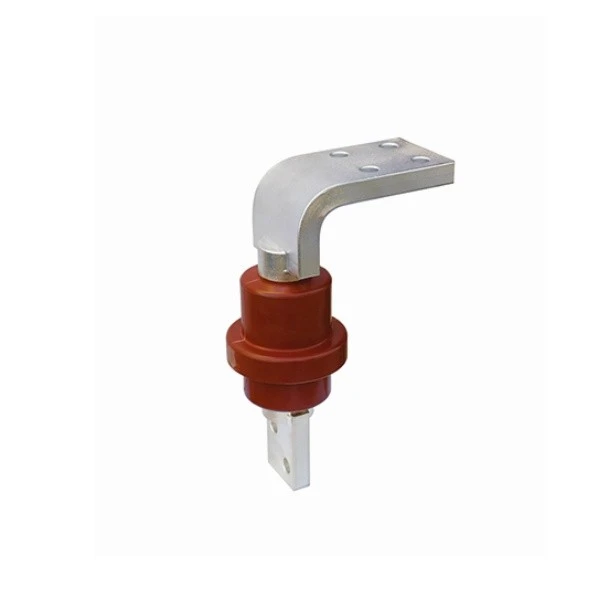
Construction & Working Principle: An electrolytic copper or aluminum conductor stem is chemically bonded and encapsulated within a mineral-filled epoxy matrix. This void-free structure equalizes local electric field distributions, provides a structural barrier against gas or oil leakage, and prevents internal corona tracking.
Dielectric dissipation factor (tan delta) <= 0.005 at 50/60 Hz
Partial discharge (PD) magnitude <= 5 pC at 1.2 Ur
Cantilever breaking load rating up to 15 kN per IEC 60137
Glass transition temperature (Tg) >= 105 degrees C verified via Differential Scanning Calorimetry (DSC)
Hydrophobic surface retention under heavy pollution conditions (for CER variants)
Technical Specifications
|
Parameter |
Specification Range |
|
Rated Voltage (Um) |
12 kV to 40.5 kV |
|
Rated Current (Ir) |
Up to 4000 A (higher ratings available for transformer monoblocks) |
|
Power Frequency Withstand Voltage |
28 kV to 95 kV (1 min) |
|
Lightning Impulse Withstand Voltage (BIL) |
75 kV to 185 kV (1.2/50 microseconds) |
|
Resin Matrix |
Acid anhydride-cured Bisphenol-A / Cycloaliphatic epoxy |
|
Inorganic Filler |
Silane-treated micro-silica (>= 65 percent weight ratio) |
|
Governing Standards |
IEC 60137, IEC 60270, IEEE Std 386 |
|
Material Compliance |
RoHS and REACH compliant raw materials |
Air-Insulated Switchgear (AIS) busbar compartments and partition walls
Gas-Insulated Switchgear (GIS) interface modules and gas-tight barriers
Power and distribution transformers (oil-to-air and plug-in configurations)
Ring Main Units (RMU) and load-break switch modules
Outdoor reclosers and sectionalizer junction boxes

Manufacturing & Quality Control
Raw Material Degassing
Automatic metering and vacuum mixing of epoxy resin, hardener, and surface-treated silica filler under < 1 mbar pressure to maintain moisture content below 0.05 percent.
APG Injection Molding
Hydraulic clamping units ranging from 50 t to 300 t injecting compound into pre-heated aluminum molds at controlled temperatures (+/- 2 degrees C) to manage exothermic reaction rates.
Thermal Curing
Multi-zone programmable ovens eliminating internal residual stresses through regulated heating and cooling gradients.
Inspection Protocols
100 percent routine partial discharge screening inside Faraday cages using IEC 60270 measurement circuits, with individual factory test reports provided per batch.
Power frequency high-voltage dielectric tests.
Ultrasonic phased-array non-destructive testing (NDT) to inspect internal homogeneity and conductor bonding.
Coordinate Measuring Machine (CMM) dimensional verification of mounting PCD and insert thread tolerances.
Customization
Conductor Integration
Custom-machined copper stems configured with straight, angled, or flat pad terminals.
Geometrical Adaptations
Non-standard creepage lengths, custom flange bolt patterns, and integrated current transformer (CT) mounting seats built to customer CAD specifications.
Capacitive Grading
Integration of internal capacitive grading foils for high-voltage applications (> 72.5 kV) to control radial and axial electric field distribution.
Hebei Anmei Electrical Equipment Co., Ltd. is one of the most professional epoxy bushing manufacturers and suppliers in China, specialized in providing high quality products and service. Please feel free to buy customized epoxy bushing made in China here from our factory. Contact us for quotation.
Flange Type LV Epoxy Bushing, LV Insulating Epoxy Bushing, epoxy bushing